

Drivers often assume motorcycles must yield more frequently or follow different traffic rules than cars. But this assumption leads to serious consequences, especially at intersections. In fact, motorcyclists are far more likely to suffer life-threatening injuries when another driver violates their right of way. According to the National Highway Traffic Safety Administration (NHTSA), motorcyclists are nearly 28 times more likely to die in a crash than passengers in a car.
Right of way isn’t about opinion — it’s defined clearly in Indiana traffic laws. Yet after a crash, motorcyclists often face an uphill battle proving they weren’t at fault, even when the law is on their side. When you’re injured and unsure how motorcycle right-of-way laws apply to your situation, a skilled Indiana motorcycle accident lawyer can help protect your rights and pursue a strong legal claim.
Sharing the Road with Motorcycles: Key Takeaways
- Motorcycles have the same legal right of way as other vehicles under Indiana traffic laws.
- Many drivers fail to treat motorcycle riders with the same caution and respect they give to other motorists.
- Violating a motorcyclist’s right of way is a leading cause of serious and fatal crashes in Indiana.
- Common misconceptions about yielding and visibility often lead to preventable accidents.
- Indiana’s modified comparative fault rule can reduce your compensation if you’re unfairly blamed.
- A skilled attorney can gather evidence, interpret state law, and build a strong claim for recovery.
How Indiana Defines Right of Way for Motorcyclists
Indiana law treats motorcycles the same as motor vehicles. That means they are subject to the same traffic rules as cars and trucks, including the right to occupy a full lane, the responsibility to obey traffic signals, and the legal right of way at intersections and during lane changes.
Indiana Code 9-21-8 outlines traffic behavior and right of way for all drivers. Nowhere does it suggest motorcycles are excluded or treated differently. Yet many drivers fail to yield when a motorcycle approaches because they underestimate speed or fail to see them altogether. In these cases, the legal responsibility remains the same: yield as the law requires.
When drivers ignore this, collisions can happen in an instant. And unfortunately, the injuries motorcyclists suffer are often catastrophic due to the lack the protection enclosed vehicles offer.
Misconceptions That Lead to Right-of-Way Violations
Drivers often misjudge how motorcycles operate in traffic. These errors lead to life-altering collisions, particularly at intersections and during lane shifts. Most of the time, it’s not about malicious intent. It’s about misinformation and inattention.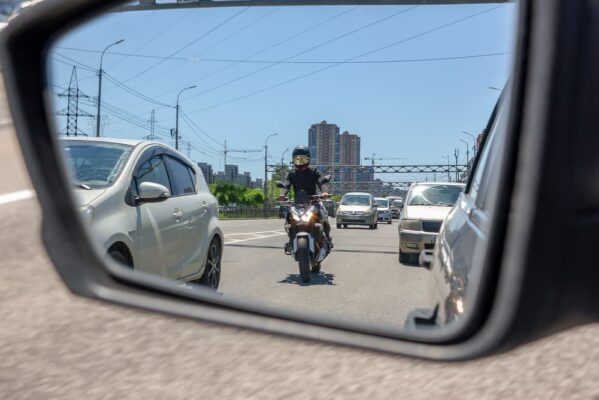
Here are common myths and mistakes that contribute to crashes:
- Assuming motorcycles must yield at four-way stops
- Believing motorcycles don’t have the right to a full lane
- Failing to see motorcycles during left turns or merges
- Thinking motorcycles are always speeding
- Not checking blind spots before changing lanes
Motorcyclists do not have fewer rights than other vehicles. But too often, they must fight harder to prove it, especially after an accident.
In many cases, the only reason a motorcycle crash becomes a legal battle is because someone falsely assumed the motorcyclist was at fault. That’s why documenting right-of-way violations and working with a lawyer who understands Indiana motorcycle safety and traffic laws is so critical.
How Right-of-Way Laws Apply in Common Crash Scenarios
Motorcycle crashes often occur under predictable conditions. And most of those stem from right-of-way violations. While each accident is unique, there are patterns that reveal how often drivers fail to yield to motorcycles when required by law.
Left-turn collisions at intersections
One of the most dangerous scenarios occurs when a car turns left in front of a motorcycle traveling straight through an intersection. Indiana law requires drivers making left turns to yield to oncoming traffic, including motorcycles. Failure to do so can result in a devastating T-bone collision.
Unsafe lane changes
Motorcycles are frequently hit when drivers change lanes without checking blind spots. Despite having mirrors, many drivers rely only on quick glances. A motorcycle may go unnoticed, especially in congested areas and amid delivery vans, trucks, and other large vehicles.
Stop sign and four-way stop confusion
Drivers often hesitate or act aggressively at four-way stops when a motorcycle is present. But the rules don’t change based on vehicle type. The first to arrive has the right of way, and ties go to the vehicle on the right. This includes motorcycles.
Driveway and parking lot pull-outs
Motorcycles are often struck when drivers pull out from parking lots, gas stations, or private driveways onto busy roads. Failure to yield to oncoming motorcycles, even if the rider is going the speed limit, is a violation of their right of way.
Each of these examples involves a clear rule under Indiana’s traffic code. But when drivers ignore these rules, the motorcyclist suffers the consequences.
Right of Way and Comparative Fault in Indiana
 Even if the law says you had the right of way, insurance companies might argue otherwise. In Indiana, liability for a crash is determined under a system called modified comparative fault. This means each party’s actions are reviewed to assign a percentage of blame.
You can recover damages if you’re found to be 50% or less at fault. But your compensation will be reduced by your percentage of fault. If you’re assigned 51% or more, you cannot recover anything.
This gives insurance companies a strong incentive to shift blame — especially in motorcycle cases where bias and false assumptions often work against the rider.
Here are some tactics they might use to reduce your payout:
- Claiming you were speeding, even without evidence
- Arguing you were in the driver’s blind spot
- Suggesting you should have anticipated the other driver’s mistake
- Saying your dark clothing made you hard to see
- Asserting you didn’t take proper evasive action
Fighting back against these tactics requires legal experience, accident reconstruction, and a deep knowledge of Indiana motorcycle laws. Hiring a motorcycle accident lawyer to handle the insurance companies gives your case legal authority and positions your case for a better outcome.
What to Do If Someone Violated Your Right of Way
If you’re recovering from a crash where your right of way was ignored, you’ve probably already seen a doctor or visited a hospital like Ascension St. Vincent or IU Health Saxony. You may still be undergoing treatment. That’s important. But so is protecting your legal claim, especially if your injuries are serious or your financial losses are growing.
Here are some steps to take after a motorcycle crash involving a right-of-way violation:
- Hire a lawyer
An Indiana motorcycle accident lawyer can take immediate steps to preserve evidence, communicate with insurers, and fight for fair compensation. - Follow all medical recommendations
Keeping up with doctor visits, therapy, or rehab helps document the extent and impact of your injuries. - Document your recovery experience
Writing in a daily journal or using video to track your pain levels, limitations, and progress adds powerful context to your claim. - Secure witness statements early
Memories fade, and neutral witnesses can be hard to find later. Early statements help preserve key facts. - Request a copy of the police report
Review it with your attorney to check for accuracy and note any statements about who had the right of way.
Taking these steps strengthens your claim and protects you from unfair accusations. Right-of-way issues often become a battle of narratives — and documentation helps clarify the truth.
“I Didn’t See the Motorcycle:” Visibility Issues in Motorcycle Accident Cases
Visibility is one of the most common factors in motorcycle crashes. Drivers often say, “I didn’t see the motorcycle,” after turning or merging into one. But not seeing another vehicle doesn’t remove legal responsibility. Drivers are expected to check blind spots, use their mirrors properly, and yield based on traffic laws, not visibility alone. Visibility issues become particularly dangerous in these situations:
- Left turns across traffic: A motorcycle’s smaller profile can make it harder to judge distance and speed, leading to premature turns.
- Dusk and dawn driving: Lighting changes can camouflage a motorcycle’s headlights, especially when sun glare is strong.
- Multi-lane roads: On highways like I-69 or Binford Boulevard, motorcycles can be obscured by larger vehicles, reducing reaction time.
Visibility doesn’t change the law. All vehicles, including motorcycles, must be treated as having equal right of way. If a driver fails to yield because they “didn’t see” a rider, that still qualifies as negligence.
Are Motorcycles Allowed to Lane Split or Share Lanes in Indiana?
Some confusion exists around lane splitting and lane sharing in Indiana. Many drivers mistake legal lane use by motorcyclists as aggressive or unlawful, leading to unjust accusations after a crash.
Here’s what Indiana law says:
- Lane splitting is illegal. Motorcyclists may not ride between lanes of traffic or pass vehicles in the same lane. This is different from California and a few other states, where lane splitting is permitted.
- Lane filtering is also illegal. While some states allow motorcycles to move between stopped or slow-moving vehicles at intersections, Indiana does not permit lane filtering under any circumstances.
- Lane sharing is legal. Two motorcycles may ride side by side in a single lane, as long as both riders consent.
- Under Indiana Code § 9-21-10-6, a motorcycle is entitled to full use of a lane. No driver may deprive a motorcyclist of that space. That includes crowding, squeezing past them in the same lane, or assuming they must move over.
Accidents involving lane sharing or splitting can become complicated. Drivers often argue they had the right of way because they didn’t see the motorcycle or assumed the motorcyclist was in the wrong. But legality depends on context, not perception.
Your Rights If You Were Hit While Riding a Motorcycle
 Motorcycle crash victims in Indiana can pursue a personal injury claim if the crash resulted from another driver’s negligence. This includes situations where the other party failed to yield, ignored your right of way, or caused a crash due to inattention or assumptions about who should yield.
Your claim may include:
- Medical expenses for emergency care, surgeries, rehabilitation, and long-term treatment
- Lost income and diminished earning capacity
- Pain and suffering, including physical discomfort, emotional distress, and trauma
- Property damage to your motorcycle, gear, or other belongings
- Permanent disability or scarring resulting from the crash
These losses must be carefully documented, and your right-of-way violation should be clearly established in the claim. The sooner you consult a motorcycle accident attorney, the sooner they can begin building your case and protecting your rights.
FAQs for Do Motorcycles Have the Right of Way?
Indiana’s statute of limitations for motorcycle accident claims is two years from the date of the accident. This deadline applies to most motorcycle crash cases. Missing it may bar you from recovering any damages.
Indiana uses a modified comparative fault system. You can still recover damages if you’re 50% or less at fault. However, your compensation will be reduced by your percentage of fault. If you’re 51% or more at fault, you may be ineligible to recover anything.
No. Lane splitting — riding between cars in stopped or moving traffic — is not legal in Indiana. Motorcyclists must remain in their lane and follow the same traffic rules as other vehicles.
Evidence may include traffic camera footage, eyewitness statements, accident scene photos, and the official police report. An attorney can also work with accident reconstruction experts to strengthen your claim.
Police reports are not the final word. Insurance companies and courts consider them, but they’re not legally binding. If the report contains inaccuracies, your lawyer can gather additional evidence to challenge or correct it.
Indiana law classifies a motorcycle as a motor vehicle for traffic rule purposes.
Specifically, Indiana Code defines a motorcycle as a motor vehicle having a seat or saddle for the use of the rider and designed to travel on not more than three wheels in contact with the ground. This definition ensures motorcyclists have the same rights and responsibilities on the road as drivers of cars and trucks, including the right of way.
Getting Help After a Motorcycle Right-of-Way Crash
If a driver cuts you off or fails to yield, the crash ends in seconds, but your medical and financial struggles continue for months or longer. Medical bills, missed paychecks, insurance delays, and pain that doesn’t go away can quickly feel defeating without the right help.
At Wyant Law, we’ve helped countless people in Indianapolis, Fishers, and across Indiana recover compensation after serious motorcycle crashes. We know the laws, the roads, and the strategies insurance companies use to reduce payouts. We know that nothing can undo all the harm you’ve suffered, but it’s our goal to maximize your compensation so that you can recover as fully as possible.
Reach out today for a free consultation. We’ll listen to your story, review your case, and explore your legal options. Call (317) 683-0333 or contact us online to speak with an Indiana motorcycle accident lawyer who will fight for your rights. You won’t pay anything unless we win your case.